

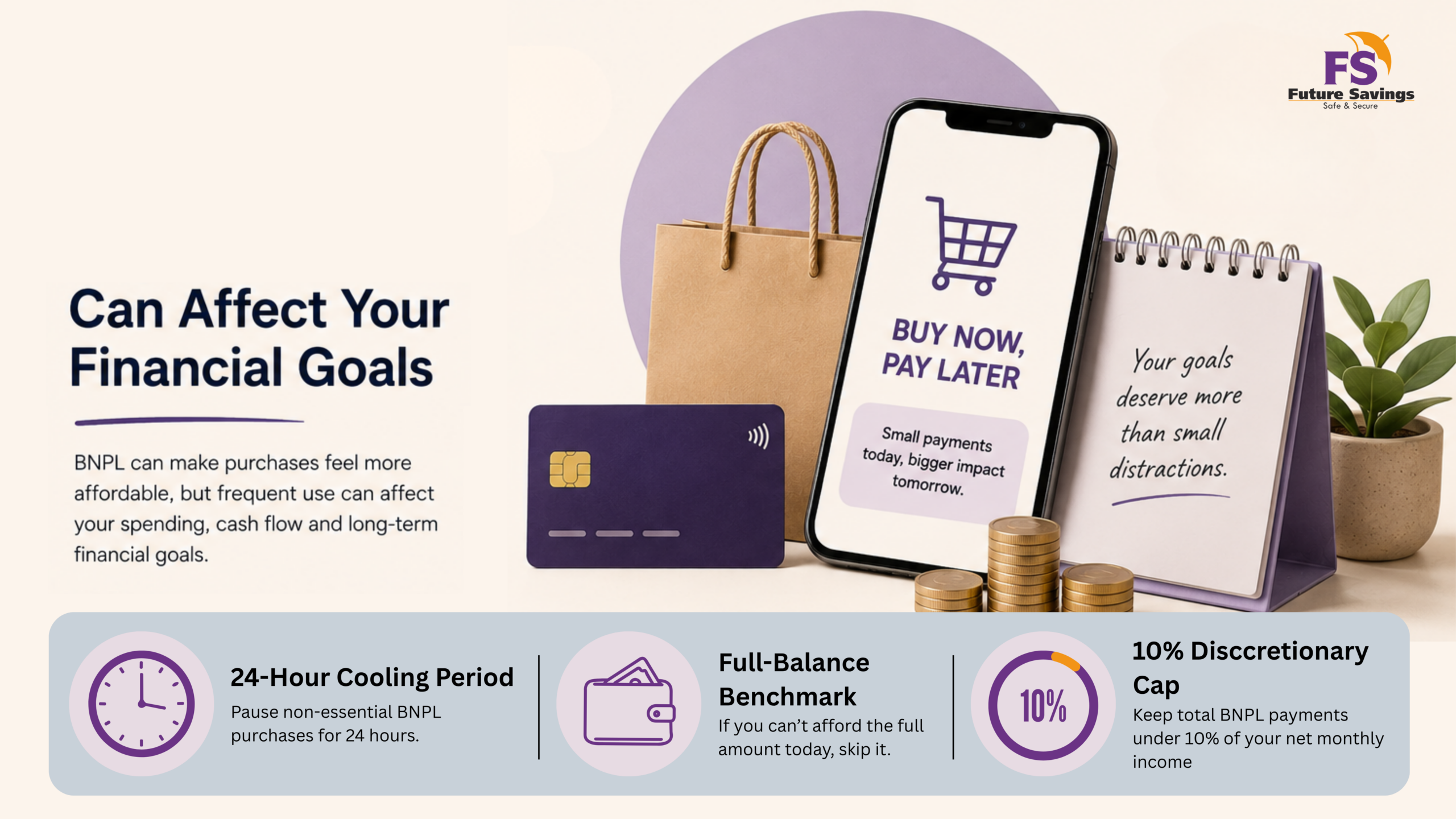
Buy Now, Pay Later (BNPL) has changed the way many people shop. Instead of paying the full amount upfront, consumers can split a purchase into smaller installments and pay over time. The convenience is appealing, especially when a purchase feels difficult to fit into the current month’s budget.
But there is an important question to ask before choosing BNPL: Can you actually afford the purchase, or does BNPL simply make it feel affordable?
While BNPL can be useful when used responsibly, frequent or unplanned use can affect your spending habits, monthly cash flow and ability to work towards long-term financial goals.
What Is ‘Buy Now, Pay Later’?
BNPL is a short-term financing option that divides a total purchase price into smaller, scheduled installments — frequently four interest-free payments over a few weeks or months.
For example, a ₹12,000 checkout balance is presented as four manageable payments of ₹3,000.
The psychological shift is immediate. Instead of evaluating a purchase against your total liquid savings (“Can I afford ₹12,000 today?”), BNPL tricks your brain into evaluating it against immediate cash flow (“Can I clear ₹3,000 this month?”). That subtle distinction frequently encourages non-essential spending that would otherwise be postponed or discarded.
On the surface, the smaller payment may appear easier to manage. However, the fact that you can divide a payment does not necessarily mean the purchase fits comfortably within your budget.
How BNPL Can Affect Your Financial Goals
1. Small Instalments Can Add Up
One BNPL purchase may not seem significant. The problem can arise when multiple purchases are made using different installment plans.
For example, you could have one instalment for a phone, another for clothing, another for a gadget and another for an online purchase.
Individually, each payment may appear manageable. Together, they can take up a considerable portion of your monthly income. This can leave less money available for savings, investments and essential expenses.
2. It Can Encourage Impulse Spending
BNPL can reduce the psychological barrier of making a purchase.
When you do not have to pay the entire amount immediately, it may become easier to justify buying something that you had not originally planned for. Over time, this can turn occasional convenience into a regular spending habit.
The concern is not necessarily one BNPL purchase. It is the possibility of using future income to continuously fund present spending.
3. Your Future Income Is Already Being Committed
Every installment represents money that you will need to set aside from future income.
If several repayments are already scheduled, a portion of your upcoming salary is effectively committed before you receive it.
This can reduce your financial flexibility when unexpected expenses arise.
4. It Can Delay Saving and Investing
Long-term wealth building depends on consistently setting aside money for future goals.
If a growing portion of your income goes towards repayments, you may have less available to build an emergency fund, invest for long-term goals or save for major expenses.
A purchase made today may therefore have an impact that extends beyond its repayment period.
5. Missed Payments Can Become Costly
BNPL plans come with specific terms and conditions. Depending on the provider and product, late or missed payments may result in fees or other consequences.
Before using any BNPL facility, it is important to understand the repayment schedule, applicable charges and other terms rather than focusing only on the installment amount.
BNPL Isn’t Always The Problem
BNPL itself is not necessarily bad.
Used carefully, it can be a convenient payment method for someone who has already planned the purchase, understood the repayment terms and has sufficient cash flow to meet every installment on time.
The bigger issue is using BNPL to purchase things that you cannot comfortably afford today. A useful rule is:
If you cannot afford the purchase without BNPL, pause and ask whether you should be making the purchase at all.
The goal should be to use BNPL as a payment convenience, not as a way to stretch your spending capacity.
How To Use BNPL Responsibly?
Before choosing a BNPL option, consider these questions:
Is this purchase necessary?
If it is an impulse purchase, waiting a few days may help you decide whether you genuinely need it.
Can I afford the full purchase price?
Look beyond the installment amount and consider the total cost of the purchase.
How many repayments do I already have?
Keep track of all existing instalments instead of looking at each purchase separately.
Will this affect my savings or investments?
If repayments are regularly reducing the amount, you can save or invest, your spending pattern may need to be reassessed.
What happens if my income is lower than expected next month?
Your repayment obligations will still remain. Make sure your cash flow can handle them.
A Professional Framework: The 3-Step BNPL Filter
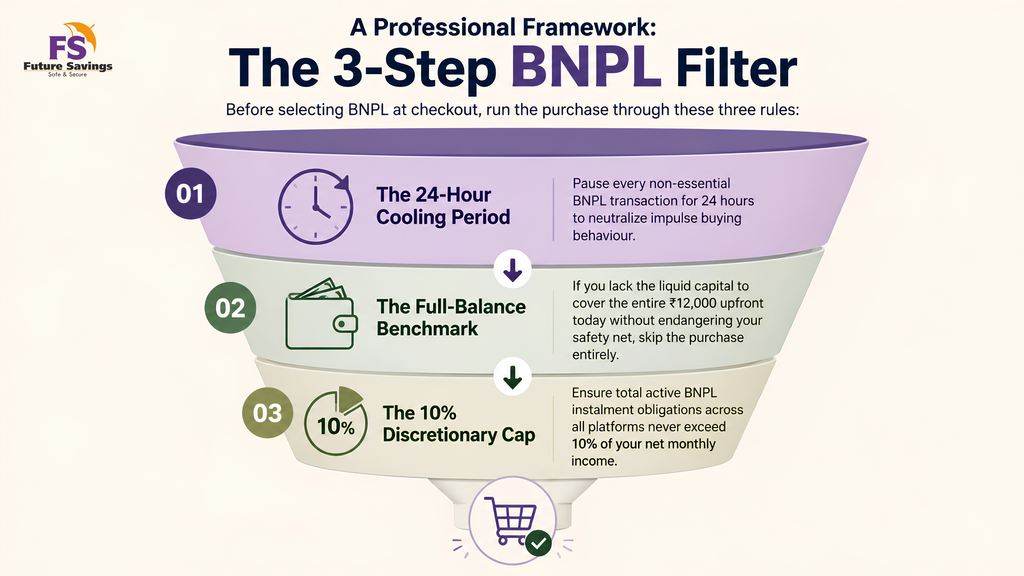
Before selecting BNPL at checkout, run the purchase through these three rules:
- The 24-Hour Cooling Period: Pause every non-essential BNPL transaction for 24 hours to neutralize impulse buying behavior.
- The Full-Balance Benchmark: If you lack the liquid capital to cover the entire ₹12,000 upfront today without endangering your safety net, skip the purchase entirely.
- The 10% Discretionary Cap: Ensure total active BNPL instalment obligations across all platforms never exceed 10% of your net monthly income.
The Bottom Line
BNPL can make payments more convenient, but convenience should not be confused with affordability. When used without planning, small instalments can gradually take up your future income and leave less room for saving, investing and achieving your financial goals.
Before choosing BNPL, look beyond the immediate instalment and consider the bigger picture: Can you comfortably afford this purchase, manage your existing commitments and still stay on track with your financial goals?
Used responsibly, BNPL can be a convenient way to manage payments. However, relying on it to spend beyond what you can comfortably afford can quickly create financial pressure.
The idea isn’t to stop spending altogether, but to make sure the choices you make today don’t get in the way of your financial goals tomorrow.
 Post Tags: