


Investing is often associated with building wealth over time. But what happens when you want to use the wealth you have accumulated without withdrawing a large amount all at once?
This is where a Systematic Withdrawal Plan (SWP) can be useful. An SWP allows investors to withdraw a fixed amount or a chosen amount from their mutual fund investments at regular intervals. It can help create a structured income stream while the remaining investment continues to stay invested.
Understanding how SWPs work, their potential benefits and the factors to consider can help investors decide whether they fit into their financial plan.
What Is a Systematic Withdrawal Plan?
A Systematic Withdrawal Plan (SWP) is a facility that allows an investor to withdraw a predetermined amount from a mutual fund investment at regular intervals.
For example, suppose an investor has ₹10 lakh invested in a mutual fund. Instead of withdrawing the entire amount, they may choose to withdraw ₹20,000 every month through an SWP.
The mutual fund units equivalent to the withdrawal amount are redeemed at the applicable Net Asset Value (NAV). The remaining units stay invested.
The frequency of withdrawals can generally be selected according to the investor’s requirements, such as monthly, quarterly or annually, depending on the scheme and available options.
How Does an SWP Work?
An SWP follows a relatively simple process:
- Invest in a mutual fund: The investor first builds a corpus by investing in a suitable mutual fund scheme.
- Choose the withdrawal amount: The investor decides how much they want to withdraw periodically.
- Select the frequency: Withdrawals can be scheduled at intervals such as monthly, quarterly or annually.
- Units are redeemed: The required number of mutual fund units are redeemed to provide the chosen withdrawal amount.
- The remaining investment stays invested: Units that are not redeemed continue to remain in the mutual fund.
The value of the remaining investment can increase or decrease depending on the performance of the underlying investments.
Why Do Investors Consider SWPs?

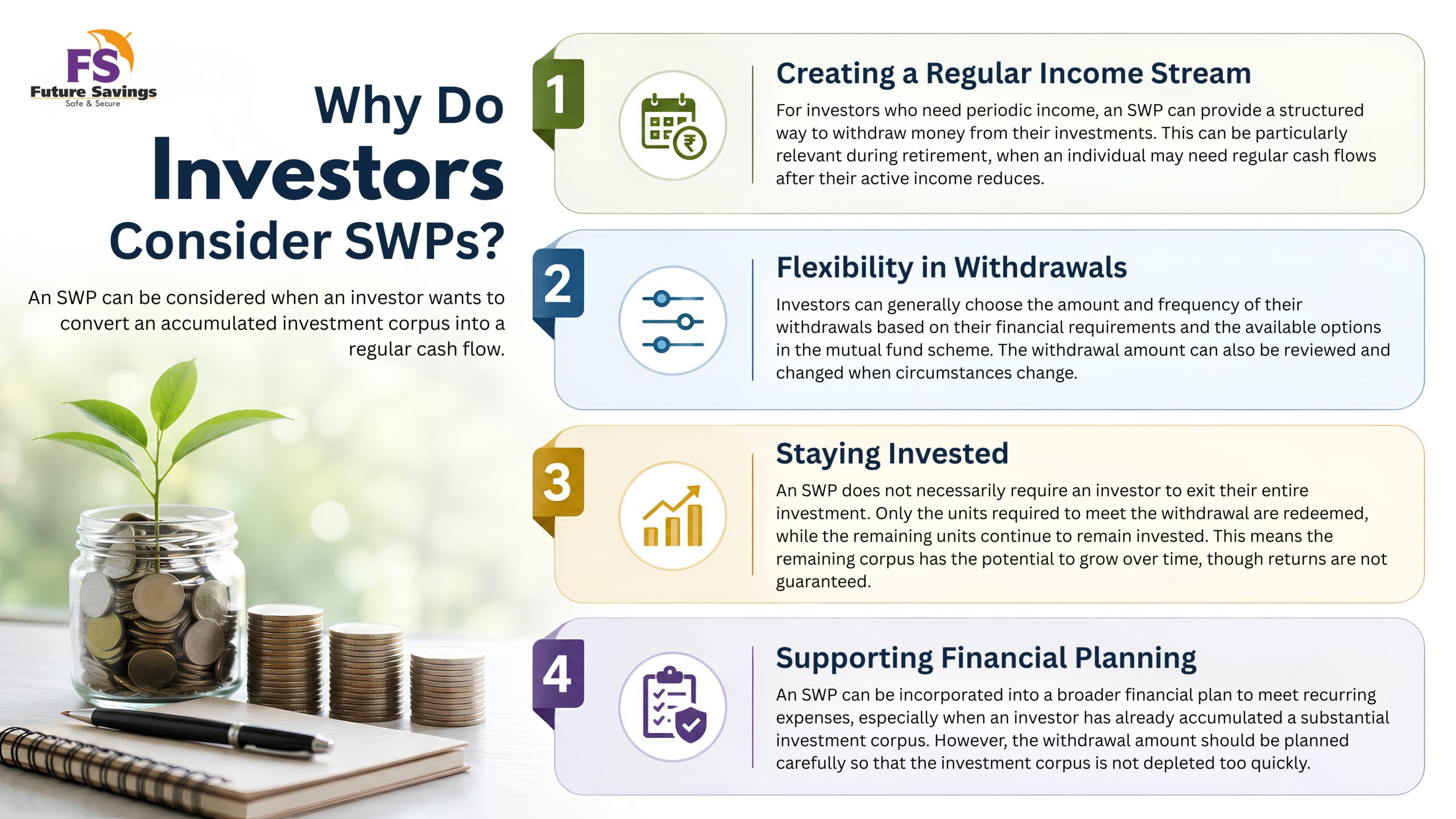
An SWP can be considered when an investor wants to convert an accumulated investment corpus into a regular cash flow.
1. Creating a Regular Income Stream
For investors who need periodic income, an SWP can provide a structured way to withdraw money from their investments. This can be particularly relevant during retirement, when an individual may need regular cash flows after their active income reduces.
2. Flexibility in Withdrawals
Investors can generally choose the amount and frequency of their withdrawals based on their financial requirements and the available options in the mutual fund scheme. The withdrawal amount can also be reviewed and changed when circumstances change.
3. Staying Invested
An SWP does not necessarily require an investor to exit their entire investment. Only the units required to meet the withdrawal are redeemed, while the remaining units continue to remain invested.
This means the remaining corpus has the potential to grow over time, although returns are not guaranteed.
4. Supporting Financial Planning
An SWP can be incorporated into a broader financial plan to meet recurring expenses, especially when an investor has already accumulated a substantial investment corpus. However, the withdrawal amount should be planned carefully so that the investment corpus is not depleted too quickly.
SWP vs. Lump-Sum Withdrawal
The difference is mainly in how the money is withdrawn.
With a lump-sum withdrawal, a large amount is redeemed from the investment at one time. This may significantly reduce the remaining corpus.
With an SWP, withdrawals are spread over a period of time. This can provide a more structured cash flow while allowing the remaining investment to stay invested.
Neither approach is automatically better. The appropriate option depends on the investor’s financial goals, cash-flow requirements, investment horizon and risk profile.
What Should You Consider Before Starting an SWP
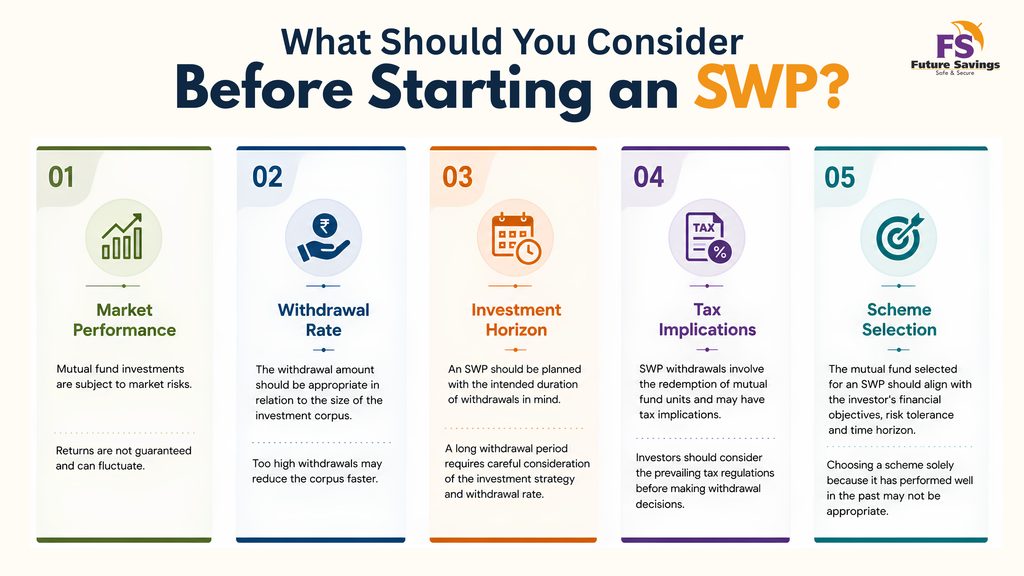
While an SWP can be useful, it is important to consider a few factors before setting one up.
Market Performance
Mutual fund investments are subject to market risks. The value of the investment can fluctuate, and returns are not guaranteed.
If withdrawals are made during a period of poor market performance, more units may need to be redeemed to meet the same withdrawal amount. This can affect the longevity of the investment corpus.
Withdrawal Rate
The amount withdrawn should be considered carefully in relation to the size of the investment corpus. If withdrawals are consistently too high, the corpus may reduce faster than expected.
Investment Horizon
An SWP should be planned with the intended duration of withdrawals in mind. A long withdrawal period requires careful consideration of the investment strategy and withdrawal rate.
Tax Implications
SWP withdrawals involve the redemption of mutual fund units and may have tax implications depending on factors such as the type of mutual fund, the holding period and the applicable tax rules.
Investors should consider the prevailing tax regulations before making withdrawal decisions.
Scheme Selection
The mutual fund selected for an SWP should align with the investor’s financial objectives, risk tolerance and time horizon. Choosing a scheme solely because it has performed well in the past may not be appropriate.
Who Can Consider an SWP?
An SWP may be considered by investors who have accumulated a mutual fund corpus and require periodic withdrawals.
It may be relevant for:
- Individuals planning for retirement income
- Investors looking for a structured way to access their accumulated wealth
- Individuals who want periodic cash flow while keeping part of their corpus invested
- Investors planning withdrawals to meet recurring financial requirements
However, an SWP is not a guaranteed income product. Its suitability depends on the investor’s overall financial situation and investment strategy.
Building an SWP Strategy
An effective SWP is not simply about deciding how much money to withdraw each month. It requires a broader approach.
Investors should consider their total investment corpus, expected expenses, other sources of income, investment horizon, risk tolerance and withdrawal requirements.
For example, someone with ₹50 lakh invested and a monthly withdrawal requirement of ₹20,000 will have a very different situation from someone with the same corpus who needs ₹75,000 every month.
Therefore, the withdrawal amount should be evaluated in the context of the entire financial plan.
The Importance of Periodic Review
Financial needs can change over time. Expenses may increase, market conditions may change, and an investor’s income requirements may evolve.
An SWP should therefore not necessarily be treated as a “set it and forget it” strategy.
Reviewing the withdrawal amount, investment performance and remaining corpus periodically can help investors make adjustments when required.
The Bottom Line
A Systematic Withdrawal Plan can provide a structured approach to accessing an accumulated mutual fund corpus while keeping the remaining investment invested.
It can be useful for creating periodic cash flow, particularly when planned carefully around an investor’s financial goals and requirements. However, an SWP does not guarantee returns or protect an investor from market fluctuations.
The key is to balance how much you withdraw with how much you need to keep invested.
With appropriate planning and periodic review, an SWP can be one component of a broader strategy for managing investments and generating income from accumulated wealth.
Disclaimer
This blog is intended for general informational and educational purposes only and should not be considered investment, financial, tax or legal advice. Mutual fund investments are subject to market risks, and returns are not guaranteed. The suitability of a Systematic Withdrawal Plan (SWP) depends on an individual’s financial goals, risk profile, investment horizon and circumstances. Investors are advised to carefully read all scheme-related documents and consult a qualified financial professional before making investment decisions. Tax laws and regulations are subject to change; investors should consider the applicable rules at the time of withdrawal.