


Table of Contents
- Why Monthly Investing Matters
- How Much Should You Invest Every Month?
- The 50-30-20 Budgeting Rule
- Monthly Investment Allocation by Income
- Invest According to Your Financial Goals
- Why Health Insurance Should Come First
- Why Term Insurance Is Essential
- Sample Monthly Financial Plan
- Common Mistakes to Avoid
- Conclusion
- Frequently Asked Questions
Why Monthly Investing Matters
Many working professionals want to build wealth but often struggle to determine how much they should invest every month. The answer depends on your income, expenses, financial goals, and existing financial commitments.
Regular monthly investing helps create financial discipline and allows you to benefit from long-term compounding. Even small investments made consistently can grow into a substantial corpus over time.
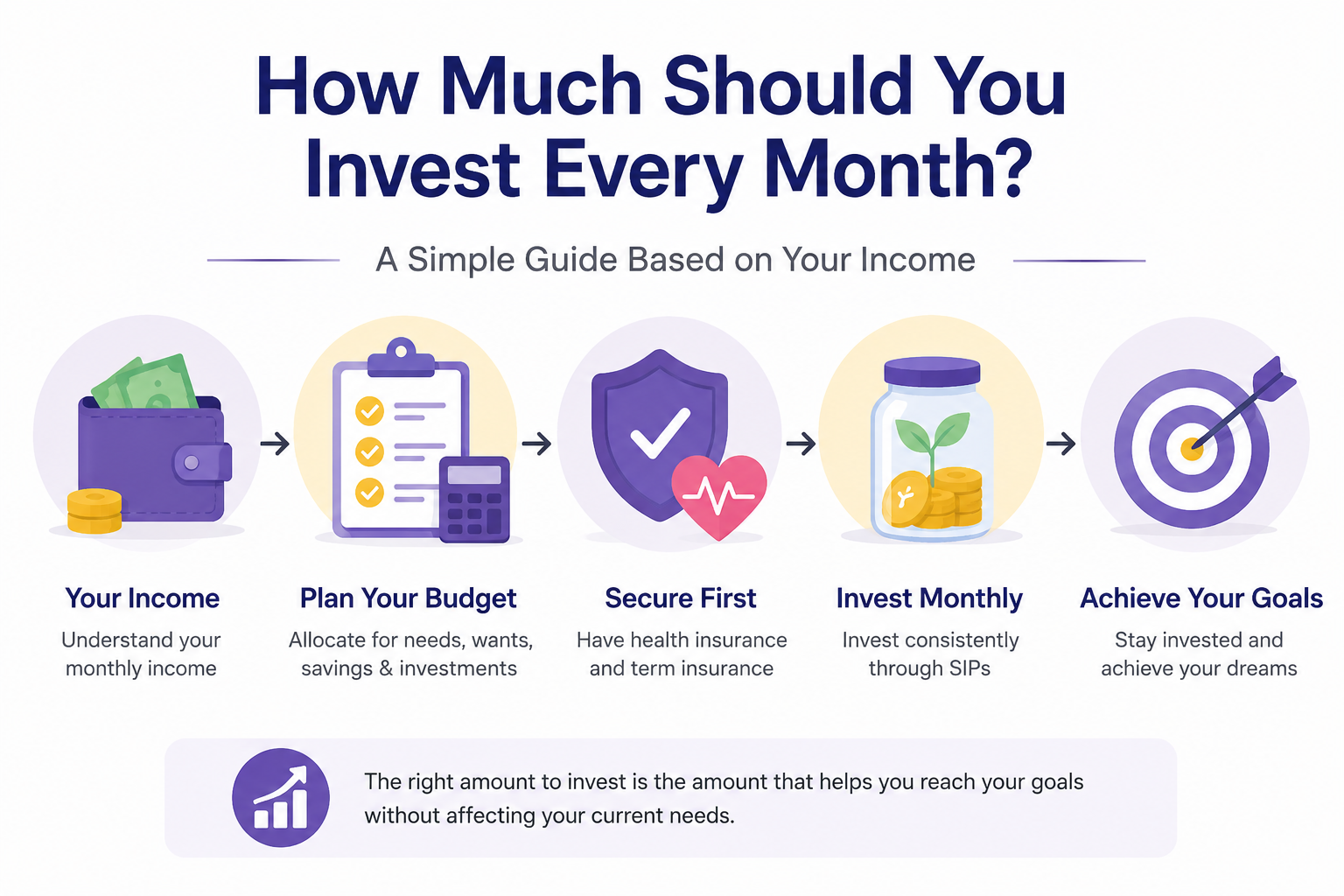
Before choosing investment products, it is important to create a budget, secure your family through insurance, and define clear financial goals.
How Much Should You Invest Every Month?
A common guideline is to invest at least 20% of your monthly income. However, the ideal percentage depends on your age, lifestyle, responsibilities, and future goals.
If you are in the early stages of your career, starting with 10% to 15% of your income can be a practical approach. As your salary increases, gradually increasing your investment contribution can significantly improve long-term wealth creation.
General Investment Guidelines
- Income below ₹30,000: Invest 10%–15%
- Income between ₹30,000 and ₹75,000: Invest 15%–20%
- Income between ₹75,000 and ₹1,50,000: Invest 20%–30%
- Income above ₹1,50,000: Invest 30% or more
The key is consistency rather than investing a large amount occasionally.
The 50-30-20 Budgeting Rule
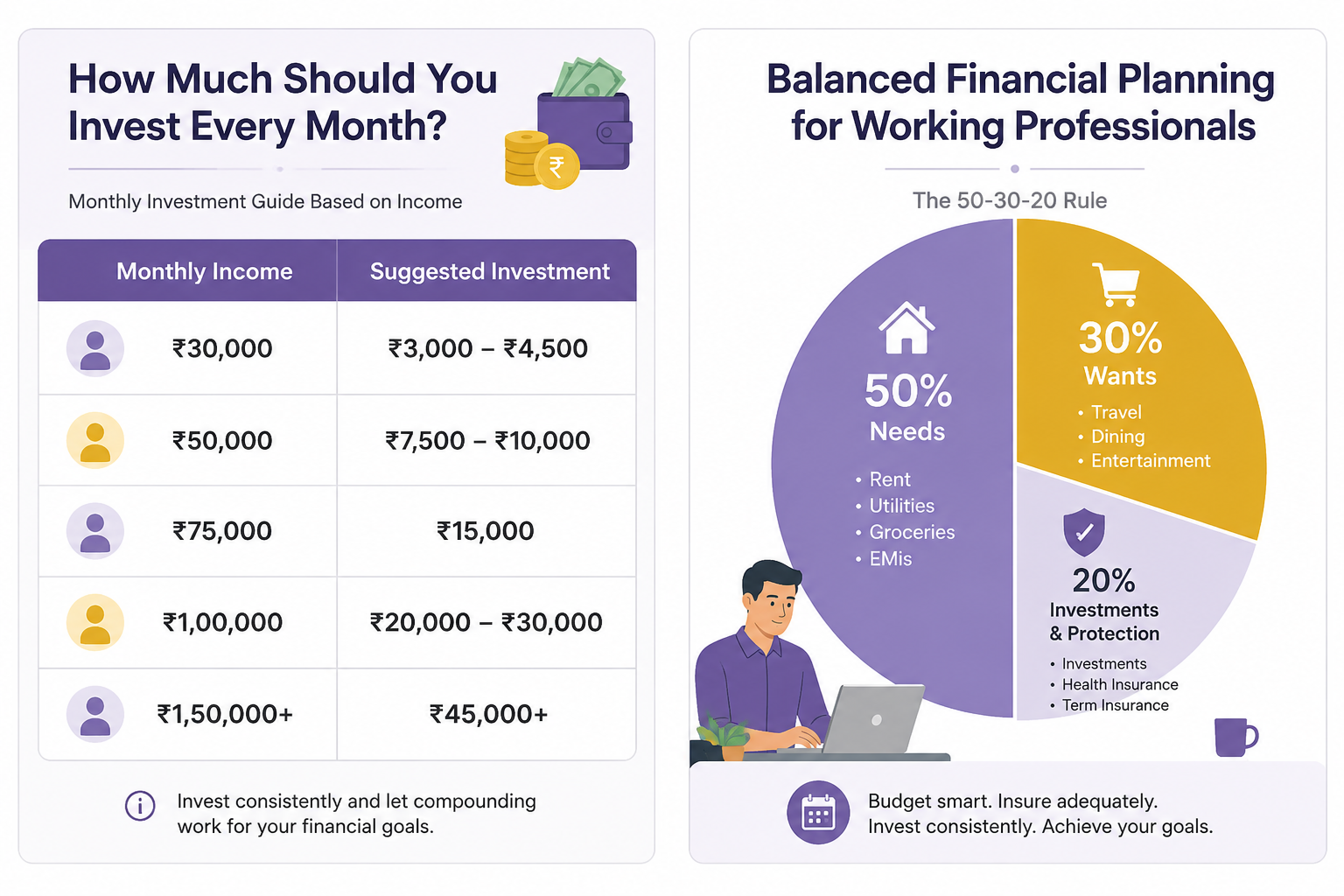
The 50-30-20 budgeting rule is a simple framework that helps working professionals manage their money effectively.
| Category | Percentage | Purpose |
|---|---|---|
| Needs | 50% | Rent, groceries, utilities, EMIs |
| Wants | 30% | Entertainment, dining, travel |
| Investments & Savings | 20% | Investments, emergency fund, goals |
This approach ensures that your current lifestyle remains balanced while still allowing you to build long-term wealth.
Monthly Investment Allocation by Income
The amount you invest should increase with your income level. Below is a simple example for working professionals.
| Monthly Income | Suggested Investment | Recommended Percentage |
|---|---|---|
| ₹30,000 | ₹3,000 – ₹4,500 | 10% – 15% |
| ₹50,000 | ₹7,500 – ₹10,000 | 15% – 20% |
| ₹75,000 | ₹15,000 | 20% |
| ₹1,00,000 | ₹20,000 – ₹30,000 | 20% – 30% |
| ₹1,50,000+ | ₹45,000+ | 30%+ |
These figures are illustrative examples and can be adjusted based on personal circumstances and financial responsibilities.
Invest According to Your Financial Goals
Investing without a goal often leads to inconsistent decisions. Every investment should be linked to a specific financial objective.
Common Financial Goals
- Building an emergency fund
- Buying a home
- Children’s education
- Retirement planning
- International travel
- Wealth creation
When your investments are tied to clearly defined goals, it becomes easier to determine how much you need to invest every month and for how long.
Why Health Insurance Should Come First
Before aggressively investing, every working professional should have adequate health insurance coverage.
A medical emergency can significantly impact your finances and force you to withdraw investments at the wrong time.
Benefits of Health Insurance
- Protects savings from medical expenses
- Provides financial security during emergencies
- Reduces out-of-pocket healthcare costs
- Offers peace of mind for families
A basic health insurance policy is one of the most important financial foundations before starting a serious investment journey.
Why Term Insurance Is Essential
Term insurance is another critical component of financial planning, especially for individuals with dependents.
Unlike investment products, term insurance is designed purely to provide financial protection to your family in case of an unexpected event.
Benefits of Term Insurance
- High life coverage at affordable premiums
- Protects family financial goals
- Helps replace lost income
- Provides long-term financial security
Many financial planners recommend securing adequate term insurance before increasing investment contributions.
Sample Monthly Financial Plan
Consider a working professional earning ₹75,000 per month.
| Category | Monthly Allocation |
|---|---|
| Essential Expenses | ₹37,500 |
| Lifestyle Expenses | ₹22,500 |
| Investments | ₹12,000 |
| Health Insurance | ₹1,500 |
| Term Insurance | ₹1,500 |
This example demonstrates how budgeting, insurance, and investing can work together to create a balanced financial plan.
Common Mistakes to Avoid
- Investing without clear financial goals
- Ignoring health insurance coverage
- Delaying term insurance purchase
- Investing irregularly
- Trying to time the market
- Spending salary increases entirely on lifestyle upgrades
- Not maintaining an emergency fund
Avoiding these mistakes can significantly improve long-term financial outcomes.
Conclusion
The amount you should invest every month depends on your income, expenses, and financial goals. While investing 20% of your income is a useful benchmark, the right amount varies for every individual.
Working professionals should first establish a budget, secure adequate health insurance and term insurance coverage, and then invest consistently toward specific goals.
A disciplined approach to budgeting and investing can help create long-term financial stability, protect your family, and build wealth over time.
Frequently Asked Questions
1. How much of my salary should I invest every month?
A common recommendation is to invest at least 20% of your monthly income, though the ideal amount depends on your financial goals and responsibilities.
2. Should I buy insurance before investing?
Yes. Adequate health insurance and term insurance should generally be considered essential financial foundations before making significant investments.
3. What is the 50-30-20 budgeting rule?
It is a budgeting framework that allocates 50% of income to needs, 30% to wants, and 20% to savings and investments.
4. Why are financial goals important for investing?
Financial goals help determine how much you need to invest, your investment horizon, and the appropriate strategy for achieving your objectives.
5. Can I start investing with a small amount?
Yes. Consistent investing, even with smaller amounts, can lead to significant wealth creation over the long term through compounding.
 Post Tags: