



Table of Contents
- What is a Fixed Deposit?
- What is a Mutual Fund?
- Mutual Funds vs Fixed Deposits: Key Differences
- Why Inflation Matters in 2026
- Wealth Creation Comparison
- Who Should Choose Fixed Deposits?
- Who Should Choose Mutual Funds?
- Can You Invest in Both?
- Conclusion
- Frequently Asked Questions
What is a Fixed Deposit?
A Fixed Deposit (FD) is a popular investment product offered by banks and financial institutions. Investors deposit a lump sum amount for a fixed tenure and earn a predetermined interest rate.
FDs are widely preferred by conservative investors because they provide stability, predictable returns, and capital protection. Since the interest rate is fixed, investors know exactly how much they will receive at maturity.
Benefits of Fixed Deposits
- Guaranteed returns
- Low investment risk
- Capital protection
- Suitable for short-term financial goals
- Easy to understand
Limitations of Fixed Deposits
- Lower return potential
- Interest income is taxable
- Limited wealth creation potential
- FD rates may not consistently beat inflation
What is a Mutual Fund?
A Mutual Fund pools money from multiple investors and invests it across various assets such as stocks, bonds, and other securities.
Professional fund managers manage these investments with the objective of generating returns for investors. Unlike Fixed Deposits, Mutual Fund returns are linked to market performance.
While Mutual Funds carry higher risk than FDs, they also offer greater long-term growth potential.
Benefits of Mutual Funds
- Higher long-term return potential
- Professional fund management
- Diversification across assets
- Better wealth creation opportunities
- Potential to outperform inflation
Risks of Mutual Funds
- Market fluctuations
- No guaranteed returns
- Short-term volatility
Mutual Funds vs Fixed Deposits: Key Differences
| Factor | Fixed Deposits | Mutual Funds |
|---|---|---|
| Returns | Fixed and predictable | Market-linked |
| Risk | Low | Moderate to High |
| Liquidity | Moderate | High |
| Inflation Protection | Limited | Better Long-Term Potential |
| Wealth Creation | Limited | High Potential |
| Tax Efficiency | Lower | Better in many cases |
Why Inflation Matters in 2026
Inflation continues to be one of the biggest challenges for investors in 2026.
While Fixed Deposits offer safety and stable returns, FD rates in India generally range between 6% and 7.5%. Although these returns appear attractive, inflation can significantly reduce the actual growth of your money.
For example, if your FD earns 7% annually and inflation remains around 6%, the real increase in purchasing power is minimal. After accounting for taxes, the effective return can become even lower.
This is why many investors are looking beyond traditional savings products and considering investments that have the potential to generate inflation-beating returns.
Historically, Mutual Funds particularly equity-oriented funds—have delivered higher long-term returns than inflation, making them a popular option for wealth creation.
Wealth Creation Comparison
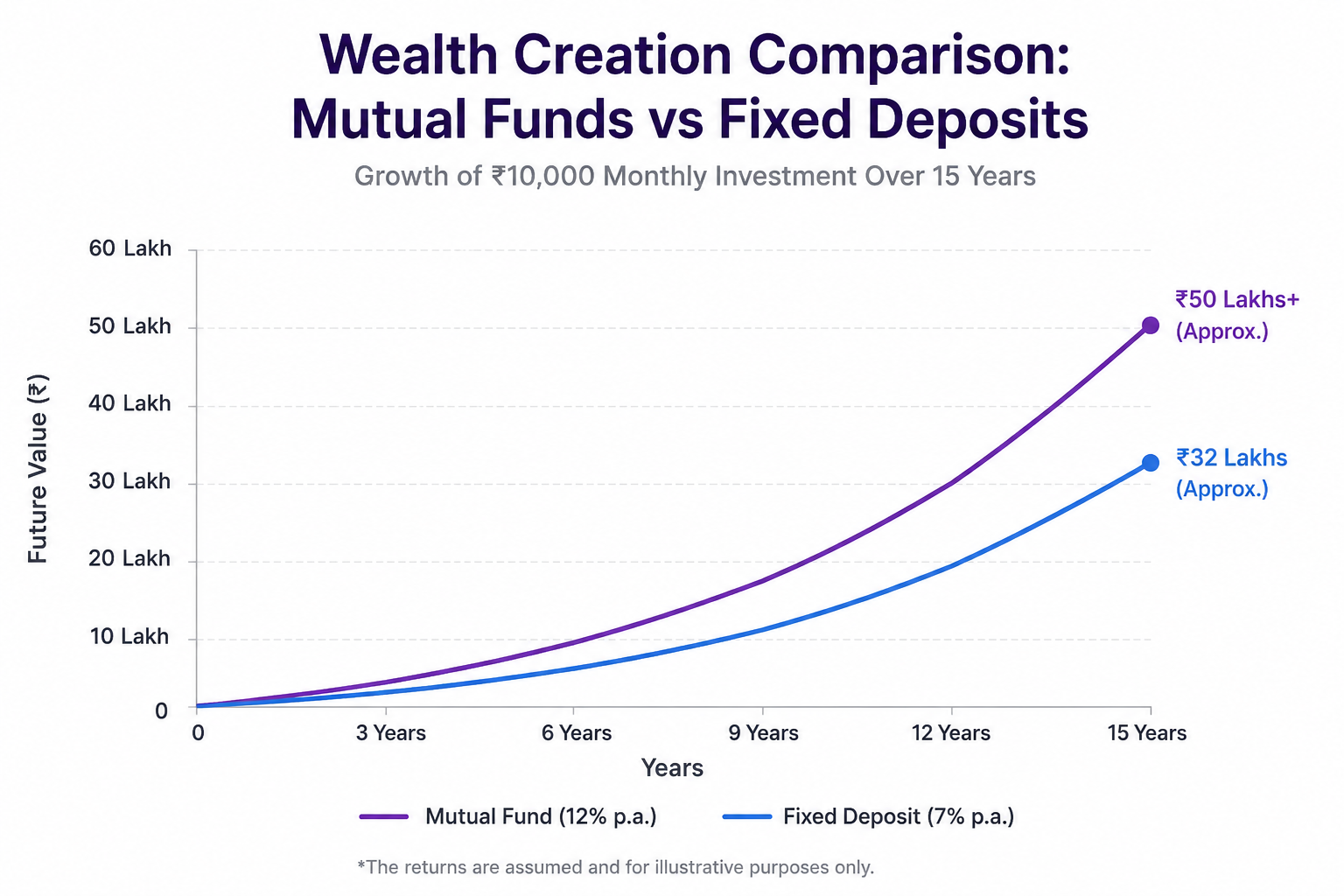
To understand which option builds better wealth, consider the following example:
| Investment Amount | Investment Period | FD (7%) | Mutual Fund (12%) |
|---|---|---|---|
| ₹10,000 Monthly | 15 Years | ₹32 Lakhs (Approx.) | ₹50 Lakhs+ (Approx.) |
This comparison highlights the power of long-term compounding.
While Fixed Deposits help preserve capital and generate stable returns, Mutual Funds have historically created significantly more wealth over longer periods.
For investors whose primary objective is long-term financial growth, Mutual Funds often provide a stronger opportunity for wealth accumulation.
Who Should Choose Fixed Deposits?
Fixed Deposits are generally suitable for:
- Conservative investors
- Retirees seeking predictable income
- Investors with low risk tolerance
- Emergency fund allocation
- Short-term financial goals
If safety and capital preservation are your primary concerns, Fixed Deposits remain a reliable investment option.
Who Should Choose Mutual Funds?
Mutual Funds are generally suitable for:
- Long-term investors
- Wealth creation focused investors
- Retirement planners
- Investors seeking higher growth potential
- Individuals looking to beat inflation
Investors with a longer investment horizon are often better positioned to benefit from the growth potential of Mutual Funds.
Can You Invest in Both?
Yes.
Many investors use a combination of Fixed Deposits and Mutual Funds to balance stability and growth.
Fixed Deposits can provide safety and liquidity, while Mutual Funds can help generate higher long-term returns and support wealth creation goals.
A balanced approach allows investors to benefit from the strengths of both investment options.
Conclusion
When comparing Mutual Funds vs Fixed Deposits in India, the right choice depends on your financial goals and risk tolerance.
Fixed Deposits remain an excellent option for conservative investors who prioritize safety and predictable returns. However, FD rates may not consistently beat inflation over the long term.
Mutual Funds, while carrying market risk, offer greater potential for long-term wealth creation and inflation-beating returns.
For investors looking to build wealth over time, Mutual Funds often provide a stronger growth opportunity, while Fixed Deposits continue to serve as a valuable tool for stability and capital protection.
Frequently Asked Questions
1. Are Mutual Funds better than Fixed Deposits?
Mutual Funds generally offer higher long-term growth potential, while Fixed Deposits provide greater stability and predictable returns.
2. Which investment has lower risk?
Fixed Deposits are considered lower-risk investments because returns are fixed and not affected by market fluctuations.
3. Why are FD returns struggling to beat inflation?
When inflation rises close to FD interest rates, the real return earned by investors becomes significantly lower. Taxes can further reduce effective returns.
4. Can Mutual Funds help beat inflation?
Historically, equity-oriented Mutual Funds have delivered higher long-term returns than inflation, helping investors grow their purchasing power over time.
5. Which investment is better for wealth creation?
For long-term wealth creation, Mutual Funds generally offer greater growth potential than Fixed Deposits due to their market-linked returns.
 Post Tags: