



Building wealth is not just about choosing the “right” investment. It is also about deciding how your money should be distributed across different types of assets.
You may invest in equities for growth, bonds or fixed-income instruments for stability, and other assets for diversification. But how much should go into each? That is where asset allocation comes in.
Asset allocation is the process of dividing your investments among different asset classes based on factors such as your financial goals, investment horizon, risk tolerance, and changing financial circumstances.
A well-planned allocation can help you balance growth opportunities with the level of risk you are comfortable taking.
What is Asset Allocation?
Asset allocation refers to how you distribute your investment portfolio across different asset classes.
Common asset classes include:
- Equities: Shares and equity-oriented investments that generally offer higher growth potential but can experience greater fluctuations.
- Fixed Income: Bonds, fixed deposits and other fixed-income investments that can provide greater stability and predictable income, depending on the instrument.
- Gold and Other Alternatives: Assets such as gold and certain alternative investments can add diversification to a portfolio.
- Cash or Cash Equivalents: Money kept readily accessible for short-term needs and liquidity.
The objective is not necessarily to maximise returns from one asset class. Instead, the idea is to create a combination that aligns with your overall financial plan.
Why Does Asset Allocation Matter?
Different investments behave differently under changing market conditions. For example, equities may provide stronger long-term growth potential but can be volatile in the short term. Fixed-income investments may offer greater stability but typically have more limited growth potential.
If your entire portfolio is concentrated in one asset class, a downturn in that area can have a significant impact on your overall wealth.
Four Factors That Can Shape Your Asset Allocation
1. Financial Goals
Start by identifying what you are investing for. Your goals could include:
- Buying a home
- Funding your child’s education
- Building retirement savings
- Creating a financial cushion
- Planning for a major future expense
Each goal may have a different time horizon and level of priority.
2. Investment Horizon
Investment horizon refers to how long you expect to remain invested before you need the money.
A longer horizon may allow you to withstand temporary market volatility. A shorter horizon generally calls for greater attention to stability and liquidity.
3. Risk Tolerance
Risk tolerance is your ability and willingness to handle fluctuations in the value of your investments.
Two people with similar financial circumstances may have completely different reactions to market volatility. Understanding your own comfort with risk is therefore important when determining an appropriate portfolio mix.
4. Changing Circumstances
Your asset allocation should not necessarily remain unchanged forever.
A new job, marriage, home purchase, approaching retirement, change in income, or a major financial goal can change the way your portfolio should be structured.
That is why reviewing your allocation periodically is an important part of financial planning.
What is Rebalancing?
Over time, your portfolio may move away from its intended allocation.
Suppose your original portfolio had a certain percentage allocated to equities and the rest to fixed income and other assets. If equities perform strongly, their share of your portfolio may increase significantly.
Your portfolio could then carry more equity exposure — and potentially more risk — than you originally intended.
Rebalancing means bringing the portfolio back towards its intended allocation.
This may involve reducing exposure to an asset class that has grown beyond its target and increasing exposure to another that has fallen below its target.
The frequency and method of rebalancing should depend on your financial plan, investment strategy, costs and tax considerations.
Common Asset Allocation Mistakes to Avoid
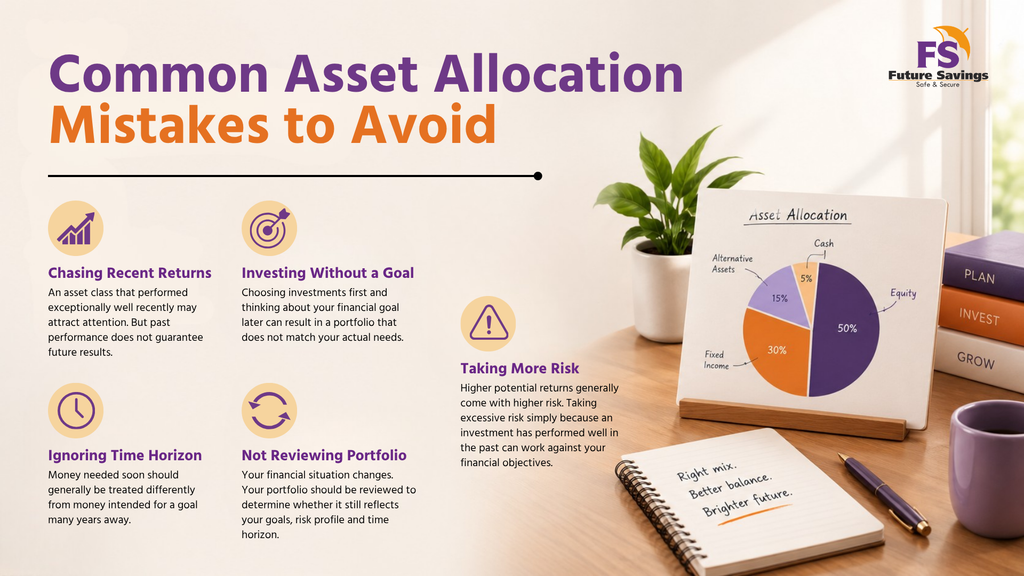
Chasing Recent Returns
An asset class that performed exceptionally well recently may attract attention. But past performance does not guarantee future results.
Investing Without a Goal
Choosing investments first and thinking about your financial goal later can result in a portfolio that does not match your actual needs.
Taking More Risk Than Necessary
Higher potential returns generally come with higher risk. Taking excessive risk simply because an investment has performed well in the past can work against your financial objectives.
Ignoring Time Horizon
Money needed soon should generally be treated differently from money intended for a goal many years away.
Never Reviewing the Portfolio
Your financial situation changes. Your portfolio should be reviewed to determine whether it still reflects your goals, risk profile and time horizon.
The Bottom Line
A strong investment strategy is about more than selecting individual investments. Asset allocation helps determine how your overall portfolio is structured and how your money is positioned for different financial objectives.
The right mix depends on your goals, time horizon, risk tolerance, liquidity needs and changing circumstances.
Rather than asking, “Which investment will give me the highest return?”, a better question may be:
“What combination of investments is appropriate for the goals I am trying to achieve?”
That shift from chasing returns to building a plan can be an important step towards more disciplined long-term investing.
This article is for educational purposes only and should not be considered investment advice. Investment decisions should be made based on individual financial circumstances, risk profile and goals, preferably with the guidance of a qualified financial professional.