


Table of Contents
- What Are Index Funds?
- What Are Actively Managed Funds?
- Index Funds vs Actively Managed Funds: Key Differences
- Which Gives Better Returns?
- Understanding Risk and Volatility
- Cost Comparison
- Who Should Choose Index Funds?
- Who Should Choose Actively Managed Funds?
- Can You Invest in Both?
- Conclusion
- Frequently Asked Questions
What Are Index Funds?
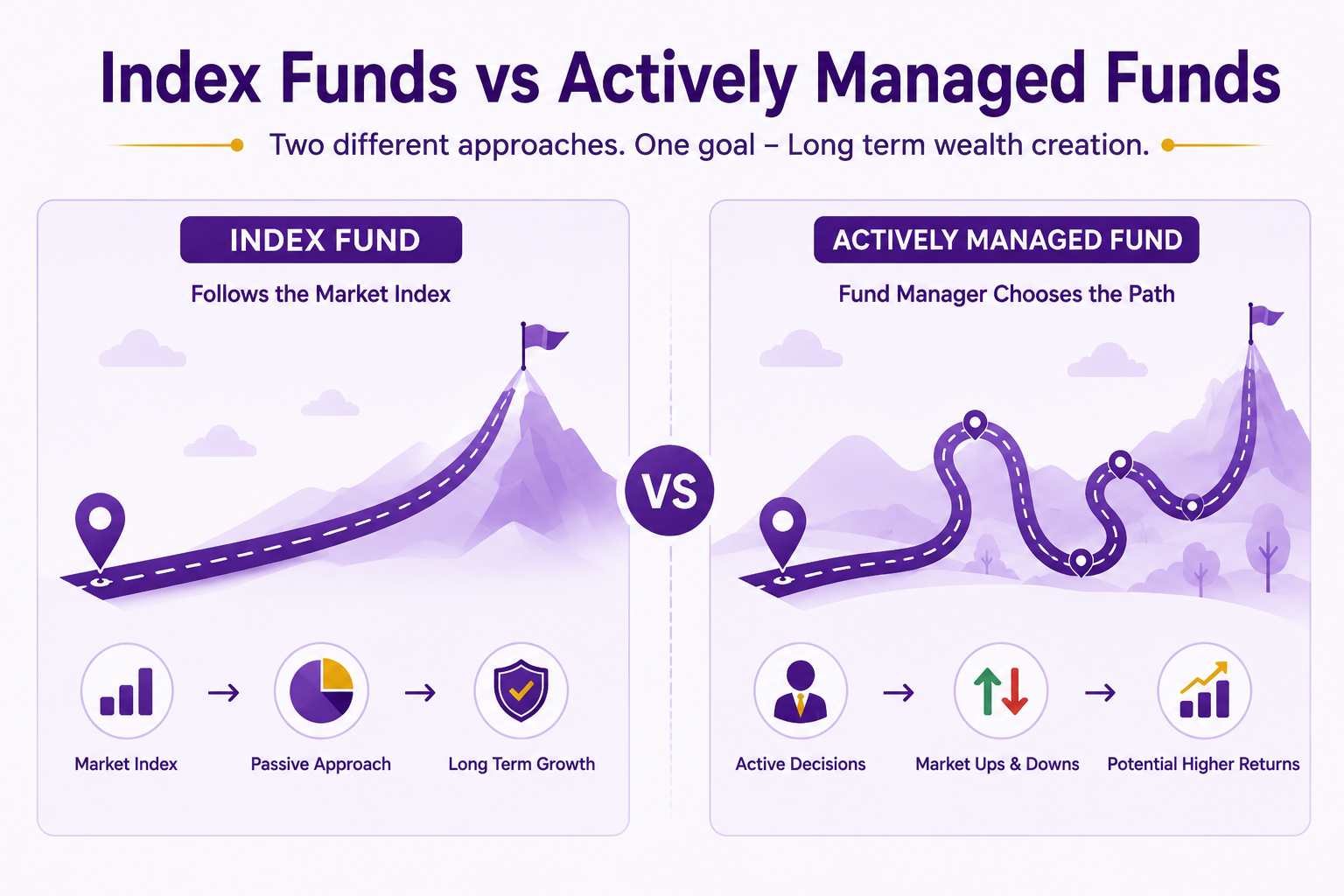
Index Funds are mutual funds designed to track a specific market index such as the Nifty 50 or Sensex. Instead of selecting stocks individually, the fund automatically invests in the same companies that form the index. Because Index Funds simply follow an index, they require less active management and generally have lower costs compared to actively managed funds.Benefits of Index Funds
- Low expense ratio
- Simple investment approach
- Broad market exposure
- Transparent portfolio structure
- Suitable for long-term investors
Limitations of Index Funds
- Cannot outperform the market index
- Returns depend entirely on market performance
- Limited flexibility during market downturns
What Are Actively Managed Funds?
Actively Managed Funds are mutual funds where professional fund managers actively select and manage investments with the goal of outperforming the market. Fund managers continuously analyze companies, economic trends, sectors, and market opportunities to make investment decisions. The objective is to generate higher returns than the benchmark index, although this is not always guaranteed.Benefits of Actively Managed Funds
- Potential to outperform the market
- Professional research and management
- Flexible investment strategy
- Ability to respond to market changes
- Access to sector-specific opportunities
Limitations of Actively Managed Funds
- Higher expense ratios
- Performance depends on fund manager expertise
- No guarantee of beating the benchmark
Index Funds vs Actively Managed Funds: Key Differences
| Factor | Index Funds | Actively Managed Funds |
|---|---|---|
| Management Style | Passive | Active |
| Objective | Match Index Returns | Beat Benchmark Returns |
| Expense Ratio | Lower | Higher |
| Fund Manager Role | Minimal | Significant |
| Portfolio Changes | Based on Index | Frequent Adjustments |
| Return Potential | Market Returns | Potentially Higher |
Which Gives Better Returns?
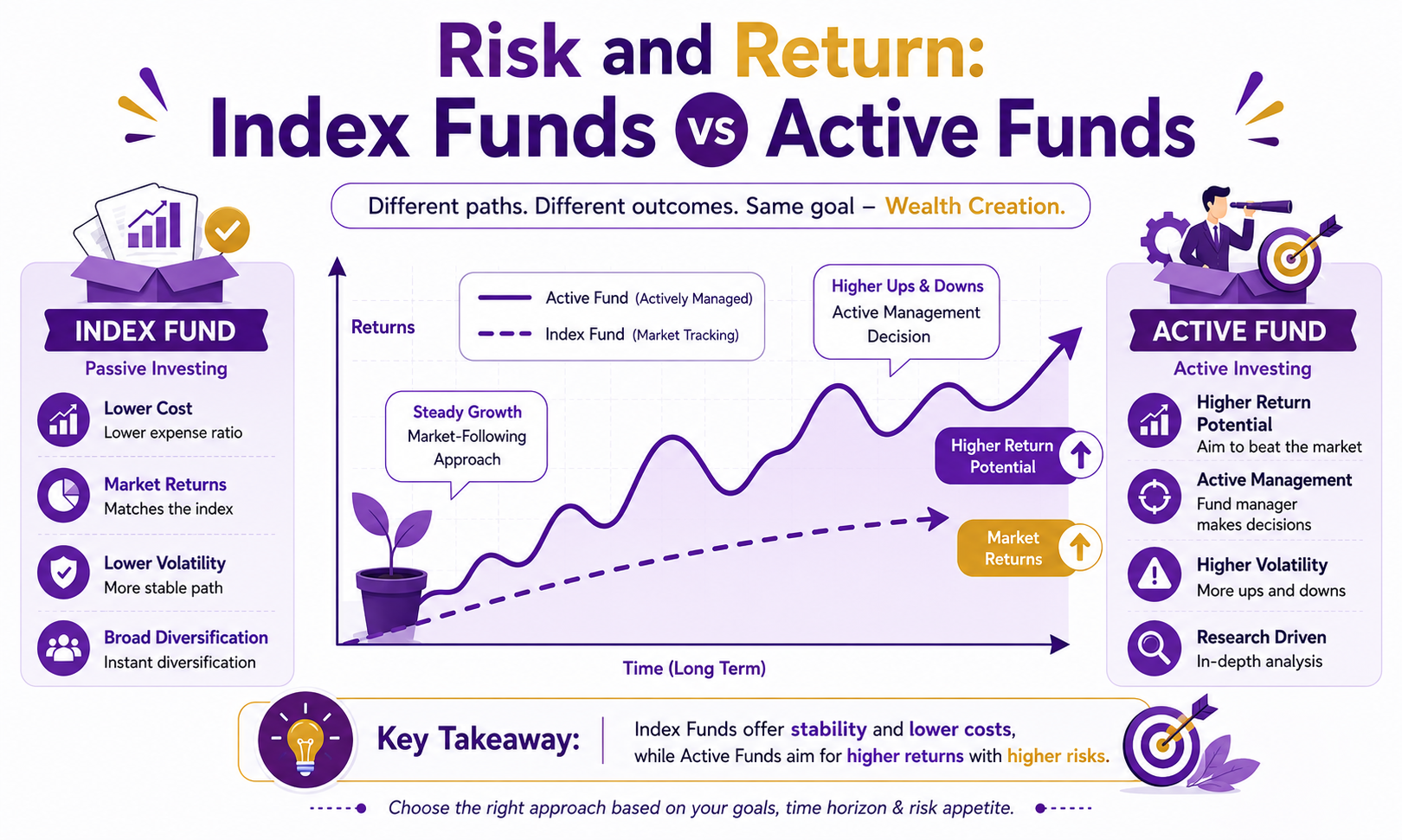
One of the most common questions investors ask is, “Which gives better returns?” The answer is not always straightforward. Some actively managed funds have historically outperformed their benchmark indices, especially during certain market cycles. However, many active funds also struggle to consistently beat the market after accounting for costs and fees. Index Funds generally deliver returns close to the market average, while actively managed funds aim to exceed those returns. For investors seeking simplicity and consistency, Index Funds can be an attractive choice. For those willing to take additional manager-related risk in pursuit of higher returns, actively managed funds may offer opportunities.Understanding Risk and Volatility
When comparing Index Funds and Actively Managed Funds, it is important to understand the difference between risk and volatility. Index Funds typically mirror the market, meaning investors experience market-wide ups and downs. Actively Managed Funds may experience different levels of volatility depending on the fund manager’s investment decisions, sector allocations, and stock selections.| Aspect | Index Funds | Actively Managed Funds |
|---|---|---|
| Market Risk | High | High |
| Manager Risk | None | Present |
| Volatility Control | Limited | Can Vary |
| Consistency | Generally Stable | Depends on Manager |
Cost Comparison
Cost is one of the biggest differences between these two fund categories.| Expense Type | Index Funds | Actively Managed Funds |
|---|---|---|
| Expense Ratio | Lower | Higher |
| Management Cost | Minimal | Higher Research Cost |
| Trading Activity | Low | High |
Who Should Choose Index Funds?
Index Funds may be suitable for:- Beginner investors
- Long-term wealth builders
- Investors seeking simplicity
- Cost-conscious investors
- Those who prefer passive investing
Who Should Choose Actively Managed Funds?
Actively Managed Funds may be suitable for:- Investors seeking market outperformance
- Those comfortable with manager risk
- Investors looking for specialized strategies
- People willing to pay higher fees for active management
- Investors seeking professional stock selection
Can You Invest in Both?
Yes. Many investors build a diversified portfolio using both Index Funds and Actively Managed Funds. Index Funds can provide stable market exposure, while actively managed funds can offer opportunities for additional returns in specific sectors or market conditions. A balanced combination allows investors to benefit from both passive and active investing approaches.Conclusion
Index Funds and Actively Managed Funds each serve different investment objectives. Index Funds offer simplicity, lower costs, and market-matching returns. Actively Managed Funds aim to outperform the market but involve higher costs and manager-related risks. The right choice depends on your investment goals, risk tolerance, and preference for passive or active investing. For many investors, the best solution may not be choosing one over the other, but combining both to create a diversified long-term portfolio.Frequently Asked Questions
1. What is the main difference between Index Funds and Actively Managed Funds?
Index Funds track a market index, while actively managed funds rely on fund managers to select investments.
2. Which fund type has lower costs?
Index Funds generally have lower expense ratios because they require less active management.
3. Can actively managed funds beat the market?
Yes, some actively managed funds outperform benchmarks, but consistent outperformance is not guaranteed.
4. Which option is better for beginners?
Many beginners prefer Index Funds because of their simplicity, diversification, and lower costs.
5. Should I invest in both fund types?
Many investors combine Index Funds and Actively Managed Funds to balance cost efficiency and growth opportunities.
 Post Tags:
Leave A Comment