

Table of Contents
- Overview: Why Filing Early Matters
- The Big Debate: New vs. Old Tax Regime in 2026
- Important Deadlines You Cannot Miss
- Checklist: Documents You Need Before You Start
- Common Mistakes That Lead to Income Tax Notices
- Conclusion
- FAQs
Overview: Why Filing Early Matters
Income Tax Return (ITR) filing is often viewed as a chore, but at Future Savings, we see it as a financial health check-up. Filing your taxes correctly is not just about compliance; it is about claiming your hard-earned refunds and building a clean financial record that helps with future loan and visa applications. With the tax laws updated in the 2026 Budget, staying ahead of the curve is more important than ever.
The Big Debate: New vs. Old Tax Regime in 2026
The 2026 tax landscape continues to push the “New Tax Regime” as the default. However, the “Old Regime” remains available for those who have significant investments.
The 2026 New Regime Slabs:
Under the New Regime, if your taxable income is up to Rs 12 Lakhs, you may pay zero tax thanks to the enhanced Section 87A rebate.
| Income Slab | Tax Rate (New Regime) |
| Up to Rs 4 Lakhs | Nil |
| Rs 4 Lakhs to Rs 8 Lakhs | 5% |
| Rs 8 Lakhs to Rs 12 Lakhs | 10% |
| Rs 12 Lakhs to Rs 16 Lakhs | 15% |
| Above Rs 24 Lakhs | 30% |
Which one should you choose?
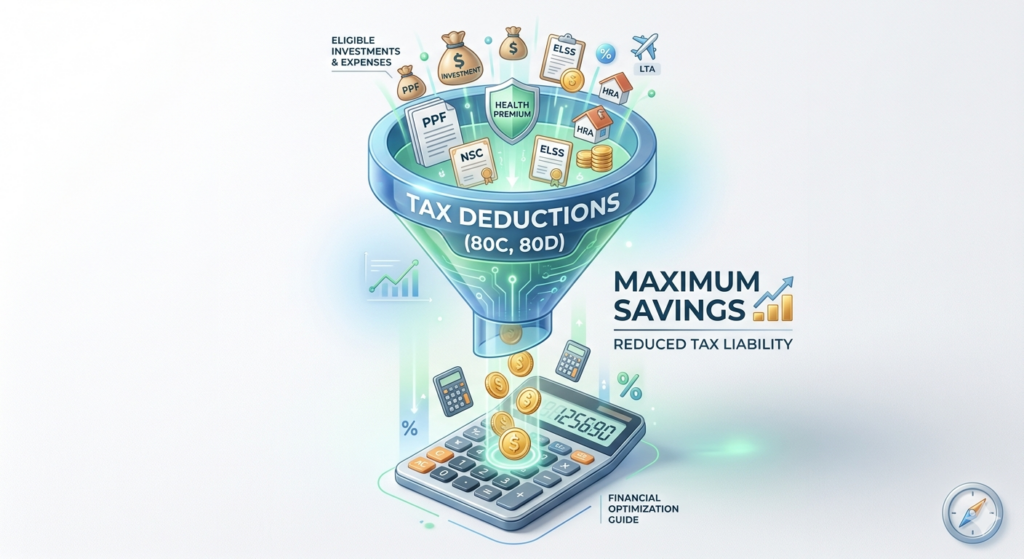
If you have a home loan (Section 24b), heavy insurance premiums (Section 80D), and ELSS/PPF investments (Section 80C), the Old Regime might still be your best bet. At Future Savings, we recommend running your numbers through both scenarios before making a final choice.
Important Deadlines You Cannot Miss
Missing a deadline results in more than just stress; it results in “Late Filing Fees” under Section 234F.
- July 31, 2026: The deadline for individual taxpayers and salaried employees.
- August 31, 2026: The deadline for non-audit businesses and professionals (ITR-3 and ITR-4).
- October 31, 2026: The deadline for businesses requiring a Tax Audit.
Checklist: Documents You Need Before You Start
To ensure a smooth filing process, gather these documents beforehand:
- Form 16: Provided by your employer (for salaried individuals).
- AIS and TIS: Download these from the Income Tax Portal. They show all your financial transactions, including stock sales and interest earned.
- Form 26AS: To verify the TDS (Tax Deducted at Source) against your PAN.
- Interest Certificates: From banks for your Savings Account and FDs.
- Investment Proofs: If you are opting for the Old Regime (Life Insurance, Mediclaim, NPS, etc.).
Common Mistakes That Lead to Income Tax Notices
Even a small error can trigger an automated notice from the department. Avoid these pitfalls:
- Not Reporting “Other Income”: Many forget to report interest from savings accounts or dividends from stocks.
- Mismatch with AIS: If your ITR doesn’t match the data in your Annual Information Statement (AIS), a notice is almost certain.
- Forgetting to E-Verify: Your ITR is not “filed” until it is verified. You have 30 days post-filing to e-verify using Aadhaar OTP.
Conclusion
Tax filing does not have to be a nightmare. By understanding the shift toward the New Tax Regime and keeping your documentation organized, you can navigate the 2026 tax season with ease. At Future Savings, we believe that tax planning should be a year-round activity, not a last-minute scramble. Start today, and ensure that your wealth is protected from unnecessary penalties and interest.
FAQs
Q: Can I change my tax regime after filing?
A: If you are a salaried individual, you can switch regimes every year at the time of filing. However, business owners generally get only one chance to switch back to the Old Regime once they have opted out.
Q: What is the penalty for late filing?
A: If your income exceeds Rs 5 Lakhs, the late fee is Rs 5,000. If your income is below Rs 5 Lakhs, the fee is capped at Rs 1,000.
Q: Do I need to file ITR if my income is below the taxable limit?
A: While not mandatory, it is highly recommended. A “Nil Return” serves as valid income proof for home loans, credit card applications, and visa processing.
Q: Is the Standard Deduction available in both regimes?
A: Yes. For the FY 2025-26 (AY 2026-27), the Standard Deduction for salaried employees is Rs 75,000 in the New Regime and Rs 50,000 in the Old Regime.
Need help deciding which tax regime is best for your portfolio? Visit www.futuresavings.in for expert financial consultation.
 Post Tags: