

Table of Contents
- Why Choosing the Right Mutual Fund Matters
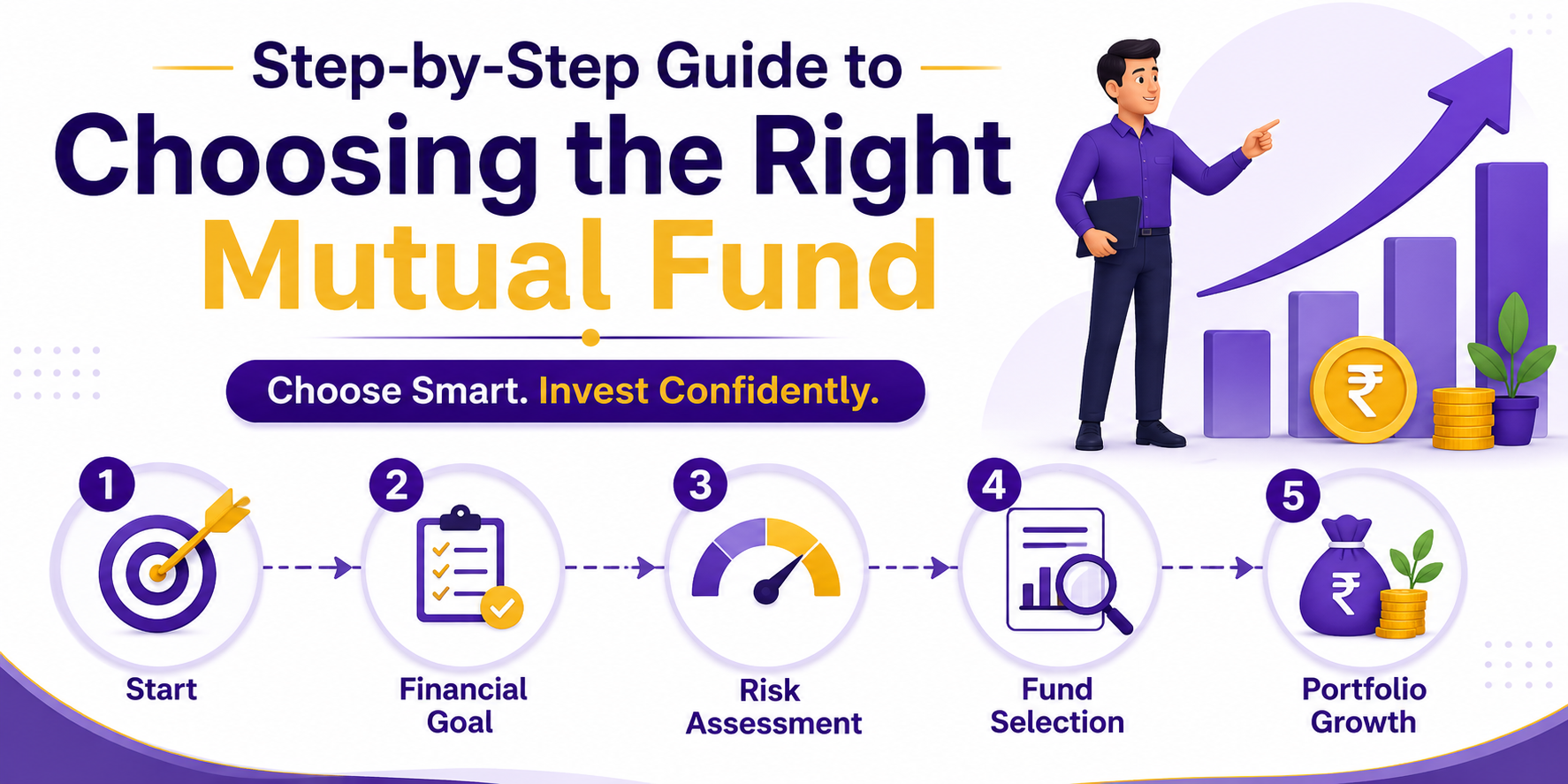
- Understand Your Financial Goals
- Assess Your Risk Tolerance
- Know the Different Types of Mutual Funds
- Check the Fund’s Investment Objective
- Evaluate Historical Performance
- Review Fund Manager Experience
- Understand Expense Ratio and Costs
- Compare Risk and Return
- Build a Suitable Mutual Fund Portfolio
- Common Mistakes to Avoid
- Conclusion
- Frequently Asked Questions
Why Choosing the Right Mutual Fund Matters
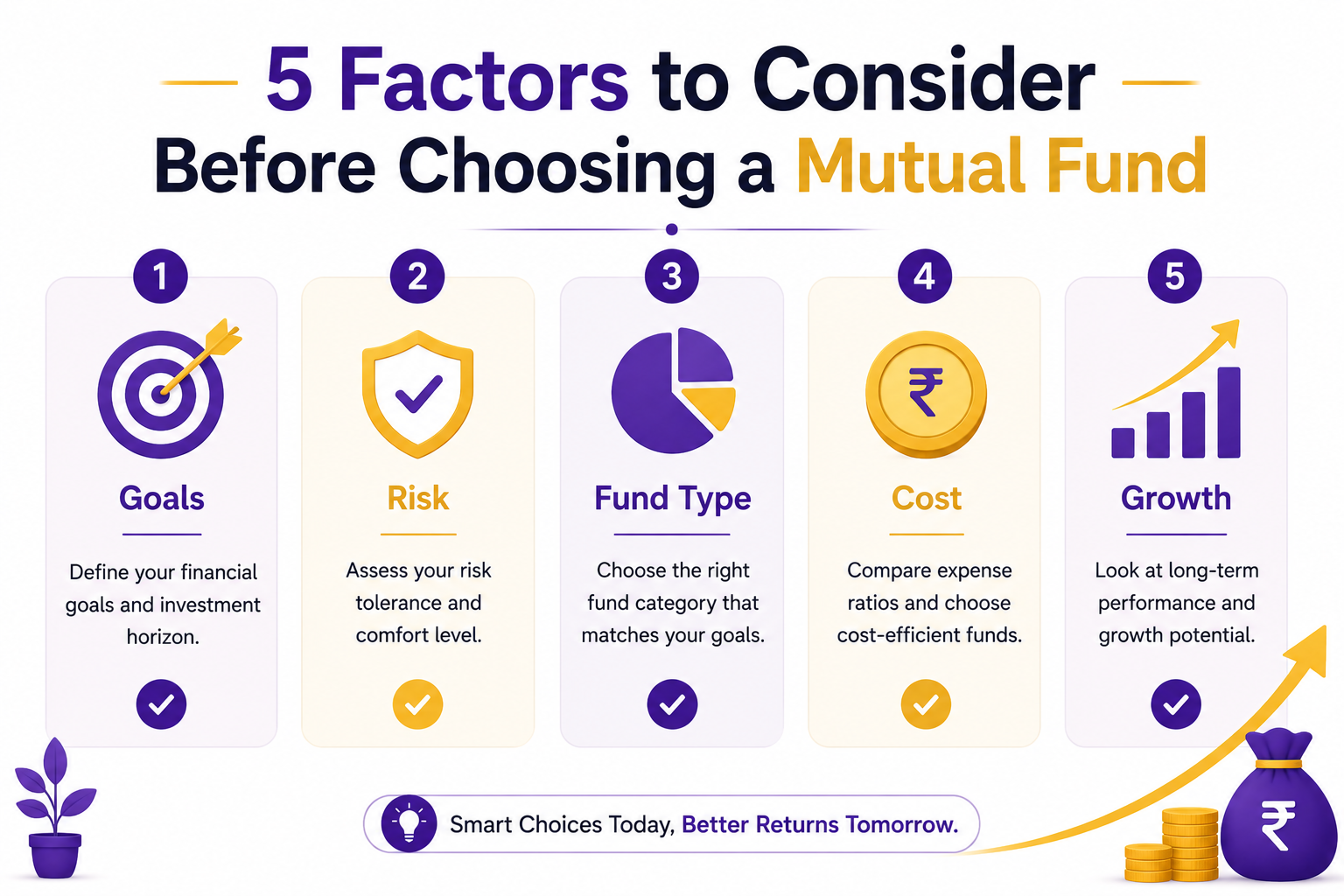
Selecting the right Mutual Fund is one of the most important investment decisions for new investors. With hundreds of funds available across different categories, choosing the wrong fund may affect your ability to achieve your financial goals. The right Mutual Fund should align with your investment objectives, risk appetite, and investment horizon. Instead of chasing recent performance, investors should focus on finding funds that fit their overall financial plan.Understand Your Financial Goals
Before selecting any Mutual Fund, identify why you are investing. Different financial goals require different investment approaches. A retirement portfolio may look very different from a portfolio built for buying a house or funding a child’s education.Common Investment Goals
- Wealth creation
- Retirement planning
- Child education planning
- Home purchase
- Financial independence
- Regular income generation
Assess Your Risk Tolerance
Every investor has a different comfort level with market fluctuations. Understanding your risk tolerance helps determine which Mutual Funds are suitable for your portfolio.| Risk Profile | Suitable Fund Types |
|---|---|
| Conservative | Debt Funds, Hybrid Funds |
| Moderate | Balanced Advantage Funds, Hybrid Funds |
| Aggressive | Equity Funds, Flexi Cap Funds, Index Funds |
Know the Different Types of Mutual Funds
Understanding Mutual Fund categories is essential before investing.| Fund Type | Purpose |
|---|---|
| Large Cap Funds | Stable long-term growth |
| Flexi Cap Funds | Diversified market exposure |
| Index Funds | Low-cost market participation |
| Mid Cap Funds | Higher growth potential |
| Hybrid Funds | Balanced risk and return |
| Debt Funds | Capital preservation |
Check the Fund’s Investment Objective
Every Mutual Fund has a stated investment objective. Before investing, review whether the fund’s objective matches your own goals. A fund designed for aggressive growth may not be suitable for investors seeking stability and lower risk. Reading the scheme information document can provide valuable insights into the fund’s investment strategy.Evaluate Historical Performance
Past performance does not guarantee future returns, but it can help investors understand how a fund has performed across different market cycles.Things to Review
- 3-year performance
- 5-year performance
- Performance during market corrections
- Consistency compared to benchmark index
- Performance relative to peer funds
Review Fund Manager Experience
The expertise of a fund manager can influence investment outcomes, especially in actively managed funds. Investors should consider:- Years of experience
- Track record managing similar funds
- Investment philosophy
- Consistency of performance
Understand Expense Ratio and Costs
Every Mutual Fund charges a fee for managing investments. This cost is known as the expense ratio. Even small differences in expense ratios can significantly impact long-term returns, especially for investors with long investment horizons.Generally:
- Index Funds tend to have lower costs
- Actively managed funds may have higher costs
- Lower expenses can improve long-term wealth accumulation
Compare Risk and Return
Many investors focus only on returns while ignoring risk. A better approach is evaluating whether the returns generated are reasonable relative to the risks taken. The ideal Mutual Fund is not necessarily the one with the highest return, but the one that provides an appropriate balance between risk and reward.Build a Suitable Mutual Fund Portfolio
Instead of investing all money in a single fund, many investors build diversified portfolios.Sample Beginner Portfolio
- Large Cap Fund
- Flexi Cap Fund
- Index Fund
- Hybrid Fund
Common Mistakes to Avoid
- Choosing funds based only on recent returns
- Ignoring risk tolerance
- Investing without financial goals
- Frequently switching funds
- Following market rumors
- Ignoring fund expenses
Conclusion
Choosing the right Mutual Fund requires more than selecting the fund with the highest recent return. Investors should consider financial goals, risk tolerance, fund category, historical consistency, management quality, and costs before making a decision. For new investors, taking a structured approach to fund selection can improve investment outcomes and support long-term wealth creation.Frequently Asked Questions
1. Which Mutual Fund is best for beginners?
Many beginners start with Index Funds, Large Cap Funds, or Flexi Cap Funds because of their diversification and simplicity.
2. How many Mutual Funds should I own?
Most investors can build an effective portfolio with a small number of carefully selected funds.
3. Should I choose a fund based on past returns?
Past performance can be reviewed, but it should not be the only factor in your decision.
4. What is the expense ratio?
The expense ratio is the annual fee charged by a Mutual Fund to manage investments.
5. Is diversification important?
Yes. Diversification can help reduce risk and improve portfolio stability over time.
 Post Tags:
Leave A Comment